Chapter 8 - Theory
2. Autonomous processes and automation risks
SS Ideal X was the very first commercial container vessel. She was converted from a World War II oil tanker to a container vessel for the Pan-Atlantic Steamship Company. Ideal X had a cargo capacity of 58 containers. Her maritime logistics career came to an end in 1965 when the spearhead of the novel maritime transportation was scrapped.
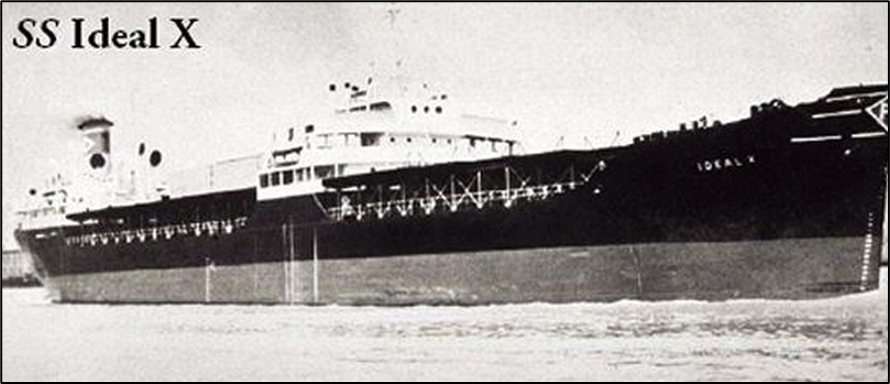
Figure 19: SS Ideal X
(Picture: Malcolm McLean, Pan-Atlantic Steamship Company 26.4.1956)
It is generally understood that the container industry has gone through massive meta-morphoses since the days of Ideal X. Today, the largest container vessel is MSC Irina. With the 399-meter hull length and a width of 61,3 meters she provides a staggering container capacity of 24346 TEU (Transport Equivalent Unit).
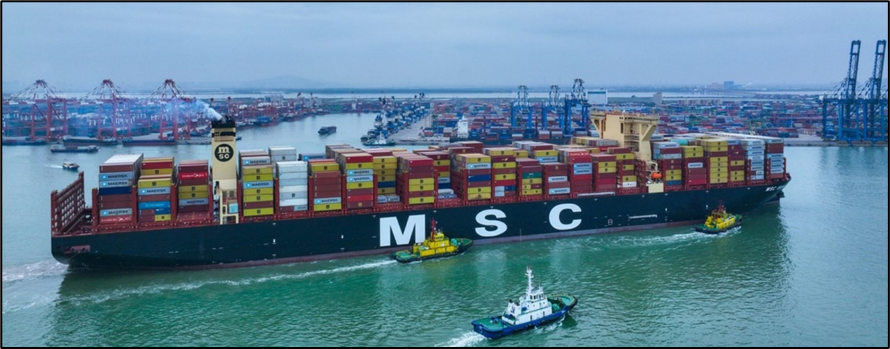
Figure 20: MSC Irina
(Picture: Orbits hub Technology Private Ltd., 2024)
Still today the demand for commerciality unites the design thresholds and operational expectations set for Ideal X and the MSC Irina. Lack of verified business cases behind the novel plan is the fastest way to rejection. While the discussion is circling the possibility of having autonomous vessels, we need to remember that man landed the moon remotely having various controls of the space flight and the landing module. Only short period of time during the actual landing on the moon the landing module was purely operated locally by a pilot. The rest of the flight mission was conducted by a Apollo Guidance Computer. The guidance computer had interfaces for navigation and control of spacecraft. This was all engineered, used and validated functional in 1966. Therefore, we can justifiably say that the reason for the absence of autonomous vessels is not the lack of technology. To immerse deeper into the rationale of a commercial case of an autonomous vessel, we need to better understand the associated risks.
Risk is likelihood multiplied by consequences. The higher the likelihood and the more severe consequences the higher the risk is. In risk management, the fundamental idea is to lower the likelihood or to lower the severity of consequences. Or to lower both, obviously. Risks appear in many different forms and categories. Below list unfolds some of the commonly recognized risks in maritime industry.
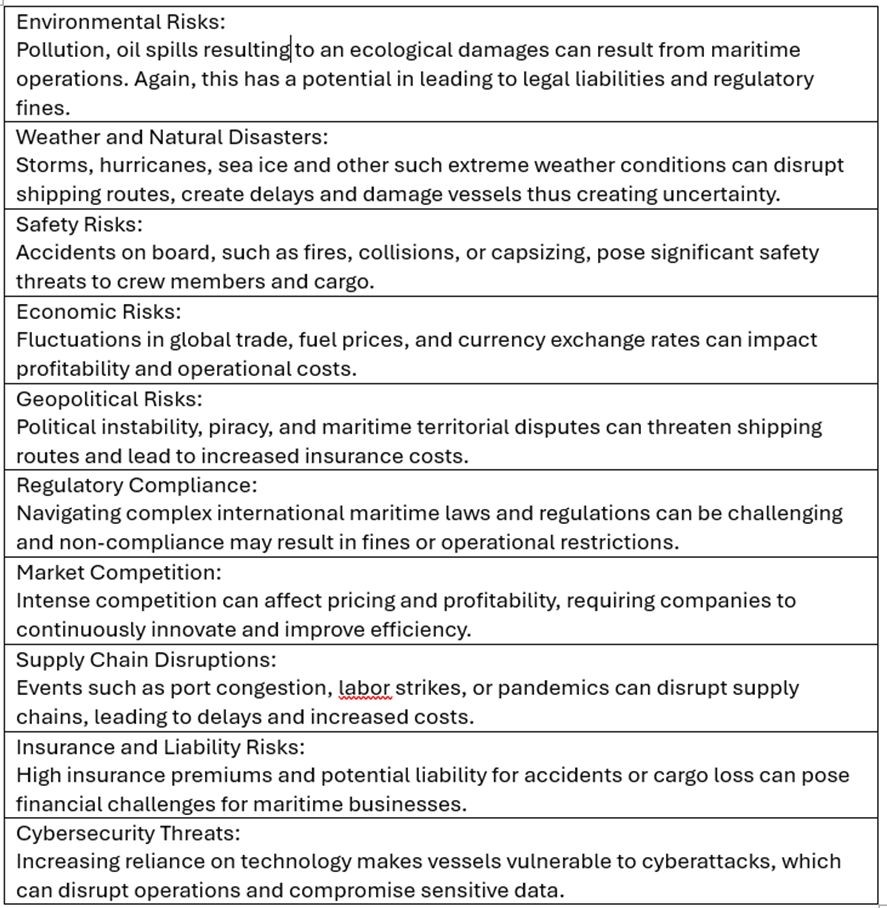
Figure 21: List of commonly recognized risks in maritime environments
(Lahtinen, 2025)
Mitigating these risks requires comprehensive risk management strategies, investment in technology, and regular training for personnel. In the above list of risks cybersecurity is mentioned last. The reliance on IT systems in managing maritime processes has made nearly everything vulnerable to cybersecurity risks. Vessel engines are online for real-time condition monitoring. Weather data is based on artificial intelligence- enhanced weather analyses and past track experience gathered. Vessel navigation systems are updated online and solely based on digitally created and presented user interfaces. Supply chains are monitored and adjusted in real time using optimization software and artificial intelligence. If we were to hurt the supply chain in shipping the cybersecurity appears to be an excellent option, as it is the IT systems are engaged to everything in today’s modern shipping. The will to hurt is an important factor in cybersecurity risk management for the obvious reason.
In risk management we have two expressions: safety and security. Safety and security are often used interchangeably, but they refer to different concepts, especially in contexts like the maritime industry. There is a clear difference between the two concepts.
First, safety refers to the protection of people, property, and the environment from accidental harm or damage. It focuses on preventing accidents and minimizing risks associated with operations. It encompasses measures taken to avoid accidents, such as training, equipment maintenance, safety protocols, and compliance with health and safety regulations. Ensuring that life jackets are available and in good condition, conducting regular safety drills, and implementing protocols to prevent slips and falls on a vessel.
Second, security involves protecting people, property, and information from intentional threats or malicious acts. It focuses on preventing deliberate harm, such as theft, sabotage, or terrorism. It includes measures to safeguard against criminal activities, unauthorized access, and other threats that could compromise safety or assets. Implementing access control systems, conducting background checks for personnel, and using surveillance cameras to monitor suspicious activities.
Finally, safety is about preventing unintentional harm, while security is about preventing intentional harm. Both are crucial for the overall protection of individuals and assets, particularly in high-risk environments like the maritime industry. We can then say that safety refers to internal threats, whereas security refers to external threats. Internal threats can be managed through our own behavior and, for example, training. External threats we can only prepare for.
As the maritime industry increasingly adopts autonomous systems, robust cybersecurity measures are essential to protect against evolving threats, ensure safe operations, and maintain the integrity of maritime activities. This requires a proactive approach, continuous monitoring, and collaboration across the industry. Transition towards growing autonomous systems may even decrease the cybersecurity risks, as the human interactions knowingly fostering risks, becomes lesser.